
What is an Analog LED Strip? #
An analog LED strip — also called a constant voltage or “dumb” strip — is a flexible tape covered in small LEDs soldered onto a PCB. The whole strip works as one unit. You can dim it, turn it on or off, or change its color, but every LED on the strip does the exact same thing at the same time.
This is what separates an analog strip from a digital LED strip (also called an addressable LED strip): with analog strips, you can’t control individual LEDs. That’s not always a problem. It makes them simpler, less expensive, and a perfect fit for jobs where you just need clean, even light across an entire area.
Which Type of Analog Strip Should You Choose? #
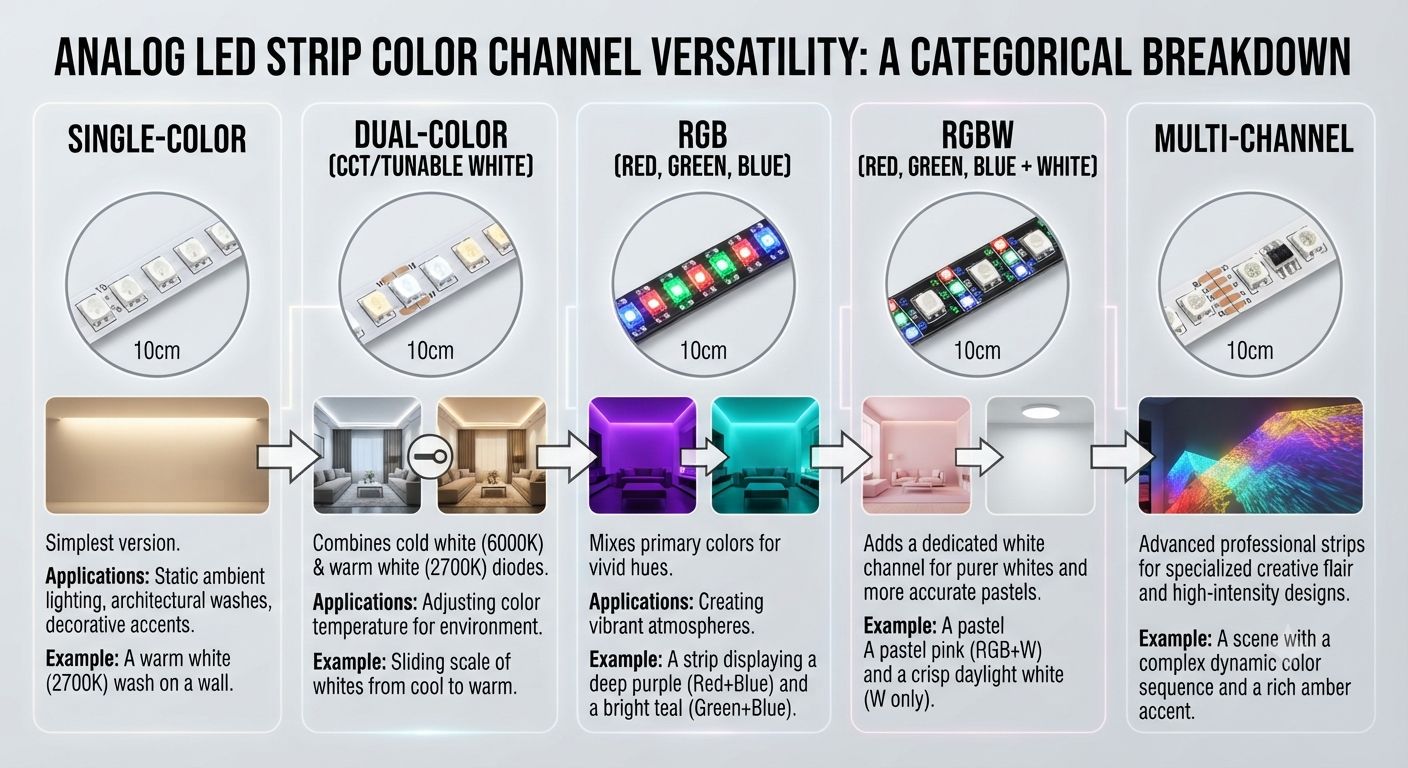
Analog strips come in several variations depending on how many color channels they support:
- Single-Color: One channel. Great for static lighting, under-cabinet accents, or architectural washes where consistent light is all you need.
- Dual-Color (CCT / Tunable White): Combines cold white and warm white LEDs in one strip. Lets you dial in the exact color temperature — warmer for restaurants and living rooms, cooler for offices or TV studios.
- RGB: Mixes red, green, and blue to produce millions of colors. The standard choice for colorful ambient lighting in bars, clubs, and stages.
- RGBW: Adds a dedicated white LED channel on top of RGB. Produces cleaner whites and more accurate pastels than a pure RGB mix. A favorite for TV studio LED lighting and hotel LED lighting where color accuracy matters.
- Multi-Channel: Advanced strips with five or more channels for specialized professional setups.
12V or 24V — Which Is Right for Your Project? #
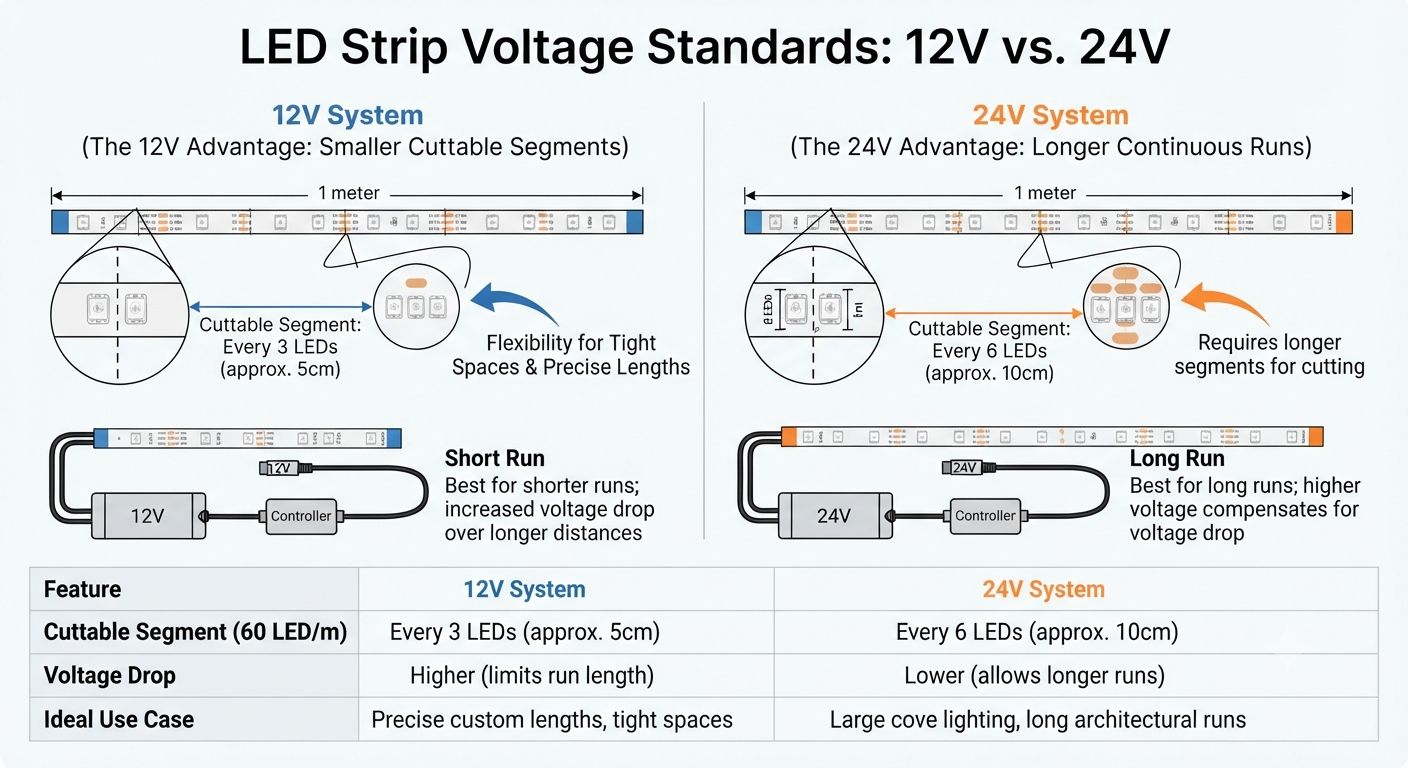
Both voltages work well. The choice comes down to two things: how tight your cuts need to be, and how long your run is.
12V strips can be cut into smaller segments. At 60 LEDs per meter, a 12V strip has a cut point every 3 LEDs — about 5 cm apart. That makes them easy to fit into tight corners or unusual custom lengths.
24V strips are better for long runs. The higher voltage handles voltage drop more effectively, so you can cover more distance without the far end going dim or shifting in color.
Short run with precise cuts? Go 12V. Covering long distances? 24V is the smarter call.
How Do You Control an Analog LED Strip? #
The right method depends on whether this is a home project or a professional installation.
Direct power is the most basic option: wire the strip straight to a power supply. It’s either on or off. Fine for a simple static accent that never changes.
Remote controllers work well enough for home use. You can dim and mix colors without any special knowledge. The downside is reliability — they’re inconvenient in larger setups and often behave unexpectedly in complex environments.
DMX LED dimmers are the professional standard for architectural LED lighting, event stage LED lighting, and TV productions. Devices like the Lady Dimmer (4-channel) or Mr. Dimmer (with a built-in 320W power supply) receive a DMX512 signal and use Pulse Width Modulation (PWM) to dim each channel independently. PWM switches power on and off at a frequency too fast for the human eye to see, which reads as a smooth, steady dimmed light. Professional dimmers run at high frequencies — critical for TV studio LED lighting where camera flicker cannot happen.
What Are Analog LED Strips Actually Good For? #
Analog strips are the right tool whenever you need even, uniform light across a large area — and individual pixel control isn’t required.
They’re the standard for residential and commercial architectural lighting: under-cabinet kitchen strips, closet illumination, backlit panels in bars, restaurants, hotels, and shopping malls. Anywhere you want a clean wash of light without hot spots or visible pixel steps.
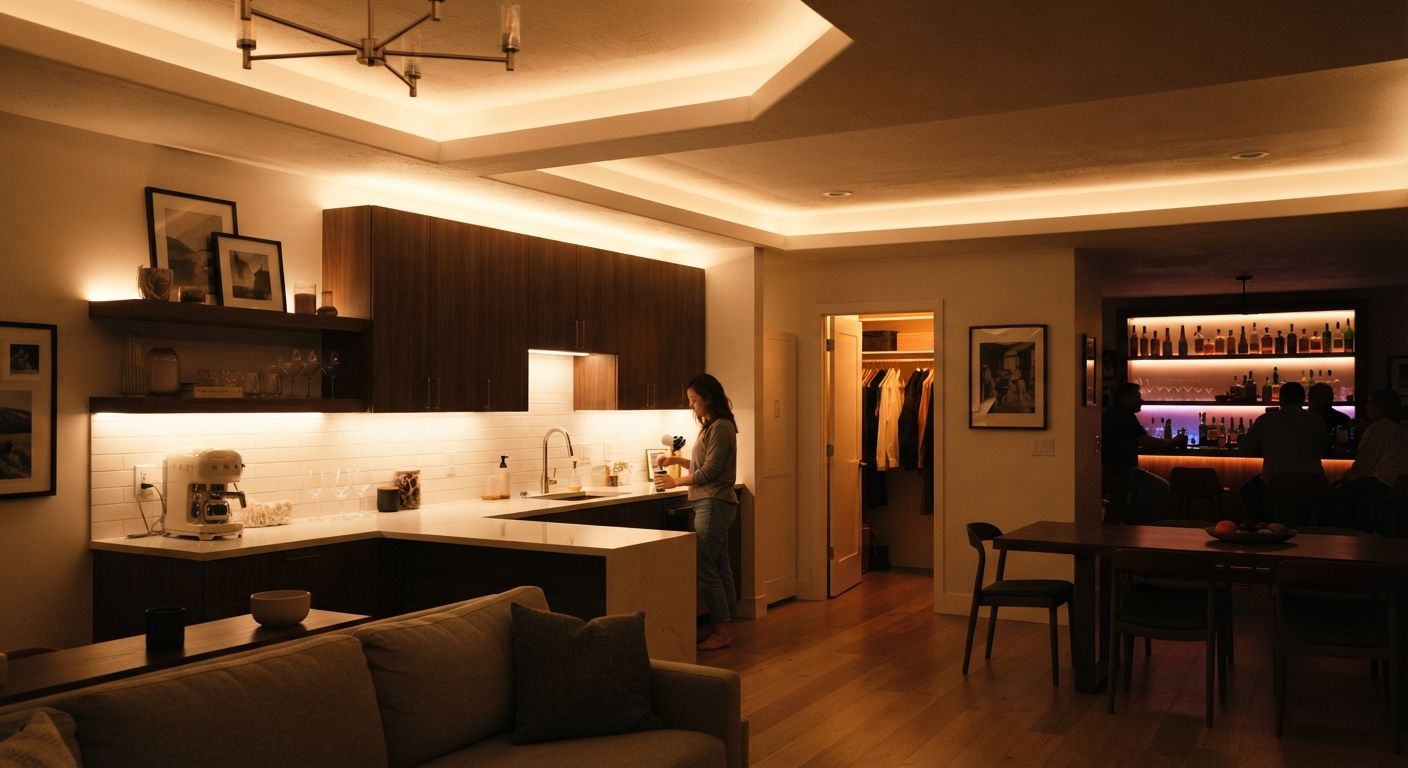
In professional environments, they’re a workhorse for nightclub LED installations, restaurant LED installations, and hotel LED lighting installations — consistent background color that’s easy to set and forget.
One less obvious use case is LED dance costumes and LED drumming suits. Analog strips are lightweight, run on small 12V batteries, and can be triggered by a DMX controller in sync with music. That makes them ideal for tron-style LED dance performances where hundreds of LEDs need to flash together on cue.
They won’t replace a digital LED strip for any job that needs pixel-by-pixel animation. But for large-scale uniform decorative lighting, they’re hard to beat on price, simplicity, and reliability.
What's the difference between an analog LED strip and a digital (addressable) LED strip?
An analog strip treats the whole tape as one unit — every LED does the same thing at the same time. A digital LED strip has a tiny chip built into each LED, so you can control every pixel independently and run animations, chases, or effects. Analog strips are simpler and cheaper. Digital strips offer far more creative control but need a pixel LED controller and more complex wiring.
Can I control an analog LED strip with DMX?
Yes. A DMX LED dimmer (also called a DMX decoder) sits between your DMX controller and the strip. It receives the DMX512 signal and uses PWM to dim or change each color channel. This is the standard setup for professional TV studio and event stage LED lighting where you need reliable, flicker-free performance frame after frame.
Should I buy a 12V or 24V analog LED strip?
If you need precise cuts — say, fitting a strip into a tight 10 cm space — go 12V. Cut points typically land every 5 cm. If you’re running the strip over several meters and want to avoid the far end going dim from voltage drop, 24V is the better choice. For most home installs, 12V is fine. For longer commercial or architectural LED lighting runs, 24V is safer.
Can analog LED strips be used outdoors?
Yes, as long as you pick the right IP rating. An IP65 strip has a protective coating that handles rain and splashing. An IP67 strip can handle brief submersion. Always pair the strip with a weatherproof power supply and seal all connectors. For outdoor LED pixel installations or facade lighting, check that everything in the chain is rated for the conditions.
Are analog strips a good choice for TV studios or stage lighting?
Absolutely — they’re a popular choice for exactly that. A DMX-controlled analog strip (RGB or RGBW) gives you smooth, flicker-free dimming that looks clean on camera. The RGBW version is especially valuable because its dedicated white channel produces clean whites that a pure RGB mix can’t match accurately. Pair it with a professional DMX LED dimmer and you have predictable, reliable color every show.
Do I need special software to control analog LED strips?
For simple setups, no. A standalone DMX controller or a basic remote is enough. For complex professional work — like syncing color changes to music or video — you’d use lighting control software over DMX or Art-Net. LED Strip Studio software can send color data to a DMX LED controller connected to your analog strips, giving you full timeline-based and effects-based control without needing a dedicated hardware console.