
There is a wide variety of LED strips. They are also called LED strips (from the English term "LED strip"). There are many types of LED strips, and they can be classified according to various criteria.
Types of LED strips by color #
–Single-color, most commonly warm and cool white, but they can also be made in pure blue, green, or red.
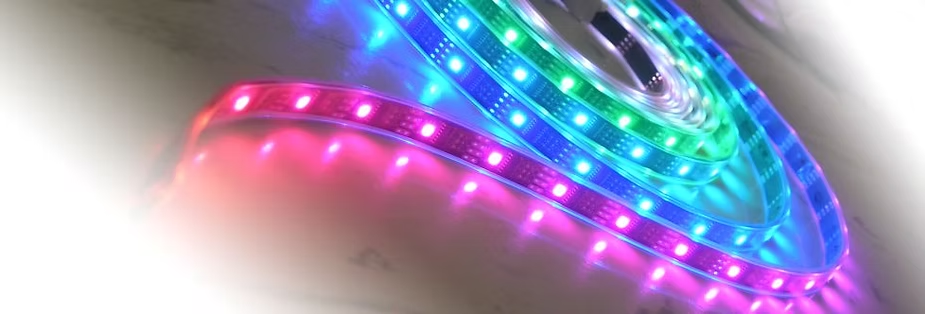
–Colorful, where the color can be changed. They are also called RGB LED strips. There are also LED strips with four color channels called RGBW LED strips.
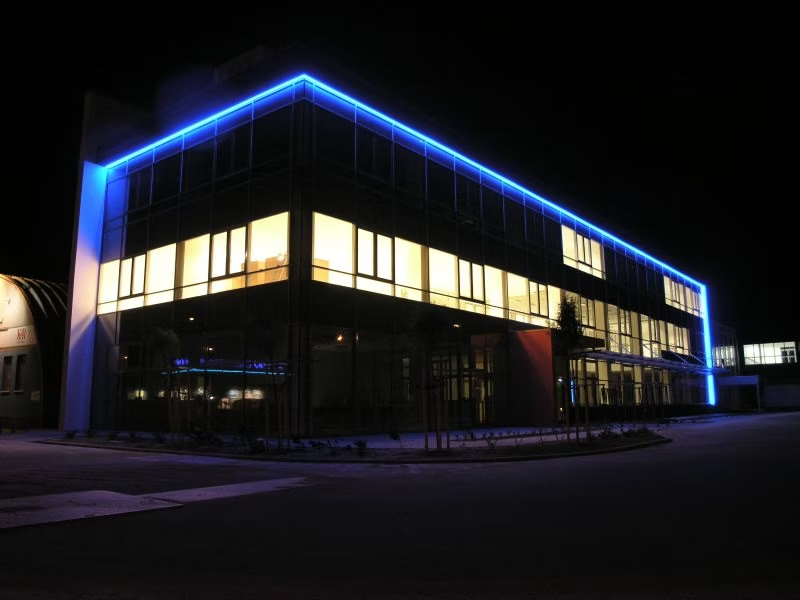
Single-color white LED strips are often used for general lighting, for example in kitchens, elevators, or for outdoor building lighting. For example, we used pure blue LED strips to illuminate the parking lot in front of the Kon-Rad building in Bratislava:
Powering LED Strips #
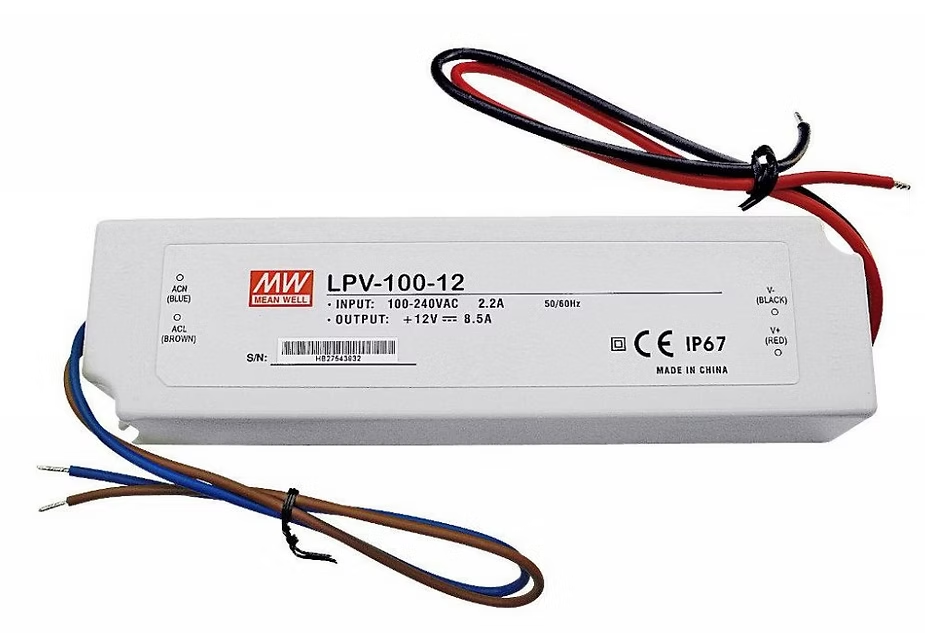
Depending on the supply voltage used, we typically distinguish between 5V, 12V, and 24V LED strips. However, you can also find more exotic voltages, such as 36V or even 220V LED strips.
Typically, the higher the voltage, the longer the segment of the LED strip can be without losing light intensity. For example, a 5-volt LED strip loses intensity after just 3 meters, while a 220V strip shines just as brightly even after 20 meters.
The voltage also determines the smallest segment of the LED strip you can cut. For example, with our 12V strips, the segment size is 5 cm, while with 24V LED strips, it is 10 cm.
Smart vs. RGB LED Strips #
Even if you use colored LED strips, the entire length of the strip has only one color (though this can be changed). Such LED strips are called RGB LED strips or analog LED strips.
We specialize mainly in so-called smart LED strips (also called pixel LED strips or digital LED strips). These allow you to control each LED light individually. Thanks to this, we can use them to create LED screens of any shape. This video explains it best:
Types of LED strip control #
If you’re using a standard single-color LED strip, you simply connect it to the appropriate power source, and it lights up when turned on. There’s no way to change the color, so it doesn’t require any special controls.
For RGB LED strips, control via DMX or DALI (in smart homes) is most commonly used. A so-called DMX LED dimmer is used for control, which can receive a DMX signal and control the intensity of each color channel (RGB).
With smart LED strips, it’s a bit more complicated. Typically, however, Art-Net is used as a universal control protocol. We also use simpler solutions, where you save animations to an SD card and then simply trigger them using buttons.
What kind of LED strip do you need? #
It depends on the application. Analog RGB LED strips are perfectly sufficient for decorative use in homes or TV studios. However, if you need the best possible effect for your building, nightclub, or TV studio, smart digital LED strips are the better choice. We can assist you with their use and installation, so please contact us.
What's the difference between RGB and RGBW LED strips?
RGB strips have three color channels — red, green, and blue — and mix them to make any color. RGBW strips add a fourth dedicated white LED, which produces a much cleaner, more natural-looking white than you get from blending full red, green, and blue together. If true white light quality matters for your project (like a TV studio or retail display), go RGBW. For pure color effects, RGB is simpler and cheaper.
Can I cut LED strips to any length I need?
You can cut them, but only at the marked cut points — usually every 5 cm for 12V strips and every ~1.7 cm for 60 LED/m strips at 5V. Cutting in the wrong place can damage the LEDs or leave a segment that won’t illuminate. The cut point spacing is actually one of the practical reasons to choose 12V over 5V for architectural work where you need precise lengths.
How long can a single run of LED strip be before I need to inject power again?
For 5V strips it’s very short — around 2.5 to 3 meters at full brightness before you see dimming and color shift at the far end. At 12V you can typically go 5 meters or more before needing to re-inject. At 220V or 24V the runs can be much longer. The rule of thumb is: the higher the voltage, the longer the segment you can run without a power injection point.
What does "smart LED strip" mean exactly?
A smart LED strip is one where each individual LED (or small group of LEDs) has its own tiny controller chip that lets it show a different color from its neighbors. Regular strips only let you change the whole length at once. Smart strips are what you need for animations, flowing effects, or anything where different parts of the strip need to do different things at the same time.
Do I need special software to control a smart LED strip?
For anything beyond a simple one-zone color, yes. A pixel LED strip needs a compatible controller and software to define what each pixel does. LED Strip Studio software handles everything from simple color effects to complex video mapping and music-reactive animations. For small home setups the LSS Remote app gives you smartphone control without needing a full PC setup.